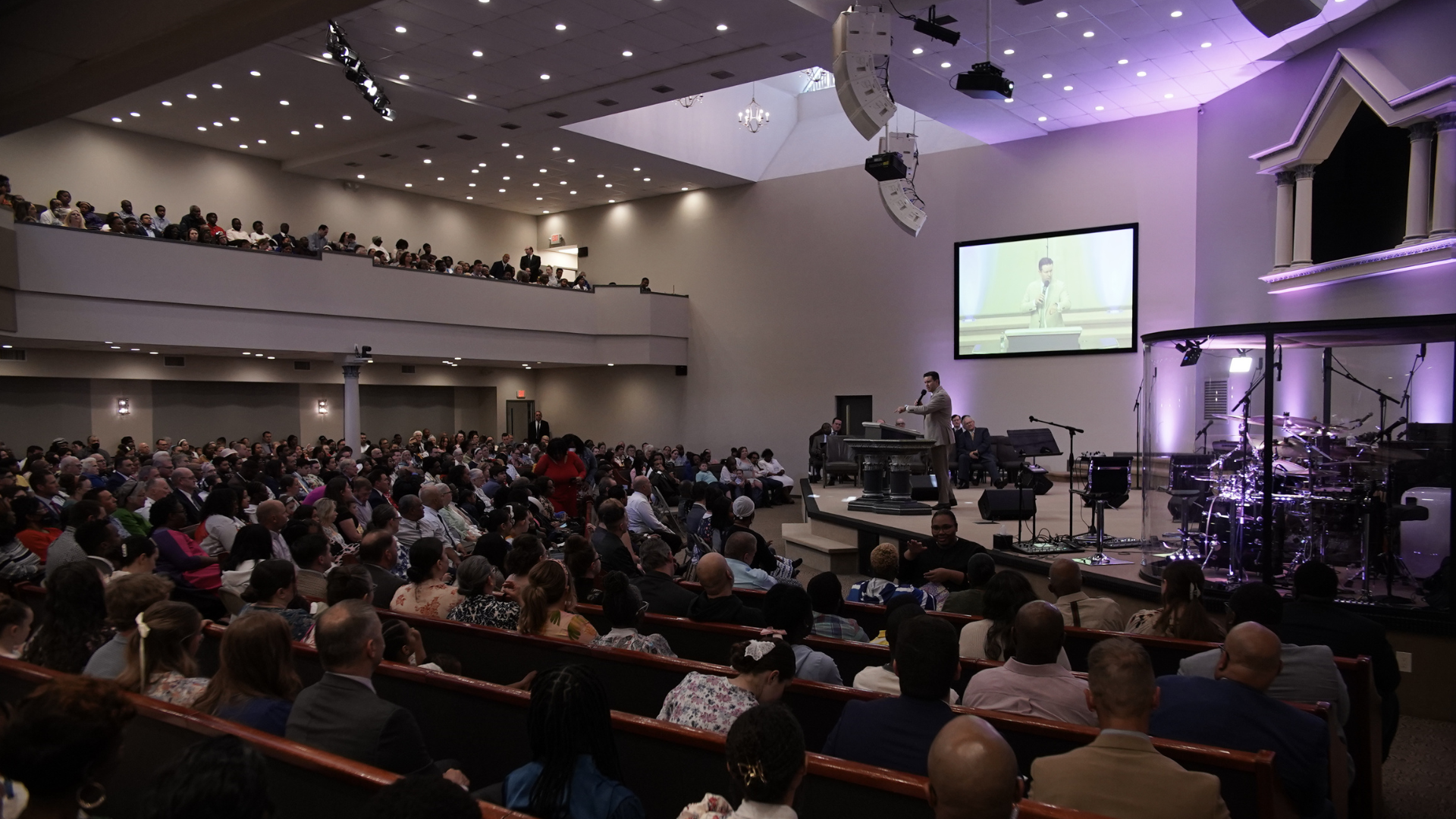
While you are snowed in, I have posted a preaching message that fits this season of the year. Also, I have included a devotional for the church to read. I wrote this early this morning and I pray it helps us as we reflect on the things of God on this wintry Sunday. God bless you and I look forward to seeing you all soon!
– Pastor Urshan
I want to hear the voice of God. In a time when so many voices and so many messages clamor for folks’ attention, a deep yearning stirs…to hear the voice of the Lord. We were made for it. We were designed for it. Yet there seems to be a shortage of venues that can lead us to the throne of God, to sit at His feet and hear what “thus saith the Lord.”
To be clear, it is not because heaven has fallen silent. God desires…longs…to speak life into the lives of His people. He speaks to those with ears to hear. Wisdom cries aloud; understanding puts forth her voice. In the high places, where paths converge, according to Solomon. There is no speech or language where heaven’s voice is not heard. It is this voice, above all others, that my soul seeks to find.
It was the voice of God that walked with Adam in the cool of the day, the gentle evening breeze rustling through Eden’s green leaves, carrying the audible sound of the Lord’s footsteps among the trees. There, in that verdant garden hush, God communed with man face to face. The divine connection was forged so that man might interact with his Maker. Every longing within us traces back to this one need: to hear Him again. When Saul, desperate and broken, turns to the witch of Endor, it is this very divine interaction he craves. After years of sinning, transgressing God’s law again and again, he now stands on the brink of his final day. Soon he will lie in the field, his lifeless eyes staring at nothing. His body will be carried to Beth-shan, his armor placed in the house of Ashtoreth the goddess of sensuality, his severed head fastened in the grim temple of Dagon the fish-god, all because he could not bring himself to pursue the voice that once spoke from heaven.
Strikingly, in death God simply allows Saul’s body to become what his spirit had already been chasing for the majority of his life. In life, his body occupied the throne, but his head…his heart…was elsewhere. How many does this describe today? How many sit on church pews while their thoughts and affections drift far away? In Saul’s judgment, God permits the body to mirror what the man had truly pursued while he lived.
Sin separates us, of course. “Behold, the LORD’s hand is not shortened, that it cannot save; neither his ear heavy, that it cannot hear: But your iniquities have separated between you and your God, and your sins have hid his face from you, that he will not hear” (Isa. 59:1–2). Heaven’s cry grows muted by iniquity, drowned by the pursuit of anything other than God. Cain turns away from hearing; by the days of Noah, and later the judges, every man does what is right in his own eyes.
What is equally sobering is that sin never satisfies. We see it plainly in the substance-abuse culture that grips so many. We see it in the endless quest for a soulmate by empty souls still searching for “the answer.” We see it in the palm readers and tarot card readers who linger on the shadowy edges of towns, waiting for modern “Sauls” to step inside, hoping to hear God’s voice, only to find deeper emptiness.
Yet it was the voice of God that finally reached Elijah in the cave. After the mighty wind tore through the mountain, ripping rocks from their places before the Lord; after the earthquake shook the very foundations of the earth beneath his feet; after the fire blazed fiercely, Elijah came to the place where he could truly hear. The still small voice spoke, a gentle whisper piercing the silence like a soft breath in the aftermath of chaos. It is that gentle voice; quiet, steady, that is so easily drowned out in today’s digital roar: the never-ending river flowing ceaselessly around us. Late-night talk shows fill the air. Early morning deejays accompany the commute. Talk radio and daytime television pour forth a relentless cacophony (loud, chaotic noise) to men and women starving for the voice of the Master. Only by shutting oneself away, by silencing the world’s clamor, can we begin to hear with Elijah the stillness of God’s Word.
God uses dramatic things to seize our attention. Man becomes so entrenched in his own ways and thoughts that the Lord must sometimes send powerful experiences to jolt us awake. Elijah’s ordeal mirrors this truth. The wind recalls Job, where God speaks from the heart of the whirlwind, roaring and swirling in majestic fury. The fire echoes Moses at the burning bush—flames leaping high in brilliant, living orange and gold, yet the branches remain untouched, unconsumed, a miraculous holy presence blazing without destruction. The earthquake recalls Sinai, where the mountain quaked violently, thick smoke billowed like a furnace, vivid lightning flashed across the darkened sky, thunder rolled in deafening peals, and the piercing blast of a trumpet grew louder and louder until the people trembled in the camp.
All these profound moments seize us (as it did them), yet none is the heart of the matter. It is the voice that matters. It is the voice that draws us back to the garden -before the bells and whistles, before the rush of life, before the distractions and temptations that lure us down dark alleys. It is God’s voice we must seek above all.
“…To day if ye will hear his voice, harden not your hearts…” (Heb. 3:15). God invites us today. This word is for every Saul still stumbling through the darkness, groping along the wall toward some modern witch’s house. Today’s “witches” wear many faces: entertainers, sports figures, political pundits -you name it. They stand ready to weave their spells, imitating God’s voice and direction. But God speaks to us “today.” While breath remains in your lungs. While health and faculties are yours. It is today. It is not too late. God still speaks. The call is now upon us: to cultivate ears that truly hear.